
Rice County Criminal Court Records
A criminal court record is the case file kept by the court after a prosecutor files a criminal case. In Rice County, felony cases and misdemeanors not under municipal jurisdiction are District Court matters. The Rice County Attorney serves as the main law enforcement officer for the State of Kansas in local criminal prosecutions. The County Attorney page states that the office handles all felony cases and misdemeanor or traffic prosecutions not under municipal court jurisdiction.
The same local source identifies the County Attorney as handling drug offenses, theft, juvenile offenses, child in need of care, criminal appeals, select traffic offenses, and care and treatment matters. City municipal courts remain separate for city ordinance and many city traffic cases. The Rice County Attorney diversion page specifically says municipal court schedules, traffic tickets, and diversion for Lyons, Sterling, Little River, and Chase are not managed by that office.
The Rice County Attorney page identifies the local prosecutor role and office duties tied to criminal case filings.

That prosecutor role is the reason a jail booking charge may later become a formal District Court criminal case record.
Search Rice County Criminal Court Records
The main online search path is Kansas Case Search for public District Court case data. Use a defendant name, case number, and county filter when available. The portal may show the case number, case type, court, filing date, docket entries, hearing settings, judge, disposition, and public documents allowed for electronic access. If the criminal case is older, paper-only, sealed, or not visible online, contact Rice County District Court.
- Search Kansas Case Search by defendant name or case number.
- Filter to Rice County District Court when the case is a county prosecution.
- Open the case and review the criminal docket, charges, hearings, pleas, and disposition.
- Check whether the docket lists sentencing, diversion, probation, restitution, or warrant events.
- Request certified copies from the Clerk of the District Court when a court-certified file is needed.
State-level criminal history and offender tools are different from court case records. KDOC KASPER tracks state prison and supervised populations, while the KBI registered offender site covers registered offenders under Kansas law. Those systems can be relevant after conviction or custody, but they do not replace the court case file kept by the clerk.
Rice County Criminal Case Flow
A Rice County criminal court record grows in stages. The court file may begin after the County Attorney files a complaint or information. The defendant then appears for arraignment or other first settings, pretrial motions may follow, and the case may resolve by plea, diversion, dismissal, trial, or sentencing. Each step can create a docket entry, order, or filed document.
Case flow: Charges Filed › Arraignment › Pretrial / Motions › Plea or Trial › Disposition › Sentencing
| Stage | What Happens |
|---|---|
| Charges Filed | The prosecutor files a complaint or information, and the court opens or updates the case file. |
| Arraignment | The defendant is advised of the charges and enters a plea such as guilty, not guilty, or no contest. |
| Pretrial / Motions | The parties file motions, request continuances, address bond, exchange information, or prepare for plea or trial. |
| Plea or Trial | The case resolves by plea, diversion path, dismissal, bench trial, jury trial, or other court action. |
| Disposition | The docket records the outcome for the case or individual counts. |
| Sentencing | The court enters punishment, probation, jail credit, restitution, fines, costs, or other conditions after conviction. |
What Rice County Criminal Records Show
Criminal court records in Rice County can include the formal charging document, probable cause material where public, bond orders, docket settings, arraignment entries, pleas, motions, diversion orders, sentencing, probation terms, restitution, jail credit, and revocation filings. Not every document is public online. Kansas Supreme Court Rule 22 controls electronic public access, and sealed or restricted material may be withheld.
| Field | What It Shows |
|---|---|
| Case Number | The District Court criminal case identifier used for search, docket review, payments, and copy requests. |
| Defendant | The person charged in the court case, with public identifiers limited by redaction rules. |
| Charges | The filed counts, offense descriptions, statutes, severity, amendments, dismissals, or reductions where public. |
| Plea | The defendant's response, such as guilty, not guilty, or no contest. |
| Motions and Orders | Requests by the parties and rulings by the judge, including bond, suppression, continuance, or other case orders. |
| Disposition | The final or count-level outcome, such as dismissed, diverted, convicted, acquitted, or closed. |
| Sentence | Probation, jail or prison term, fines, costs, restitution, conditions, jail credit, or post-sentence actions. |
Rice County Charges vs Convictions
A charge is not the same as a conviction. A charge is an accusation filed by the prosecutor or municipal prosecutor. A conviction follows a guilty plea, no contest plea accepted as a conviction, or verdict. A Rice County criminal court record may show filed charges that were amended, reduced, dismissed, diverted, or ended in acquittal. For a focused explanation of booking charges and filed court charges, use the Rice County arrest records and charges page.
| Point | Charge | Conviction |
|---|---|---|
| Meaning | An accusation filed in court or listed in early case activity | A final finding based on plea or verdict |
| Timing | Appears near the start of a case and may change | Appears after plea, trial, or accepted case resolution |
| Record Impact | May remain visible even if dismissed unless sealed or expunged | Can affect sentencing, probation, driver records, custody, and later expungement analysis |
| Best Source | Charging document and docket entries | Disposition, journal entry, and sentencing order |
Diversion in Rice County Criminal Records
Diversion can appear in a Rice County criminal court record when the defendant enters an agreement to complete conditions. The Rice County Attorney diversion page says applicants download and complete the application, then deliver it in person or by mail to the County Attorney with a $25 application fee by check or money order. Cash is not accepted. The page also lists ineligible categories for traffic diversion, including speeding 20 mph and over the posted limit, excessive driving offense record, any violation issued to a CDL holder, prior DUI diversion, and DUI conviction involving accident with injury or death.
The Rice County Attorney diversion page gives the local diversion application route and payment limits.

Diversion can affect how a criminal case is read because successful completion may avoid a conviction, while the underlying case and agreement may still be part of the court history unless restricted.
Sealed vs Expunged Records
Restricted criminal records are not all restricted for the same reason. Juvenile records, sealed court records, expunged cases, mental health or care and treatment material, and personal identifiers follow different rules. Kansas expungement under K.S.A. 21-6614 can limit public access to eligible convictions, arrest records, and diversion agreements after waiting periods and statutory conditions.
| Point | Sealed | Expunged |
|---|---|---|
| Public Visibility | Hidden from ordinary public access by court order or law | Public access is limited after the court grants statutory expungement |
| How It Happens | By statute, court rule, or judge's order for protected records | By petition in the court tied to the conviction, arrest, or diversion |
| Who May Still See It | Courts, agencies, parties, or others authorized by law | Courts, law enforcement, licensing bodies, or other authorized users in some situations |
| Rice County Action | Ask District Court about the order or case status | Review K.S.A. 21-6614 and verify filing needs with District Court |
The Kansas expungement statute is the core legal source for many criminal court record restrictions after a qualifying petition.
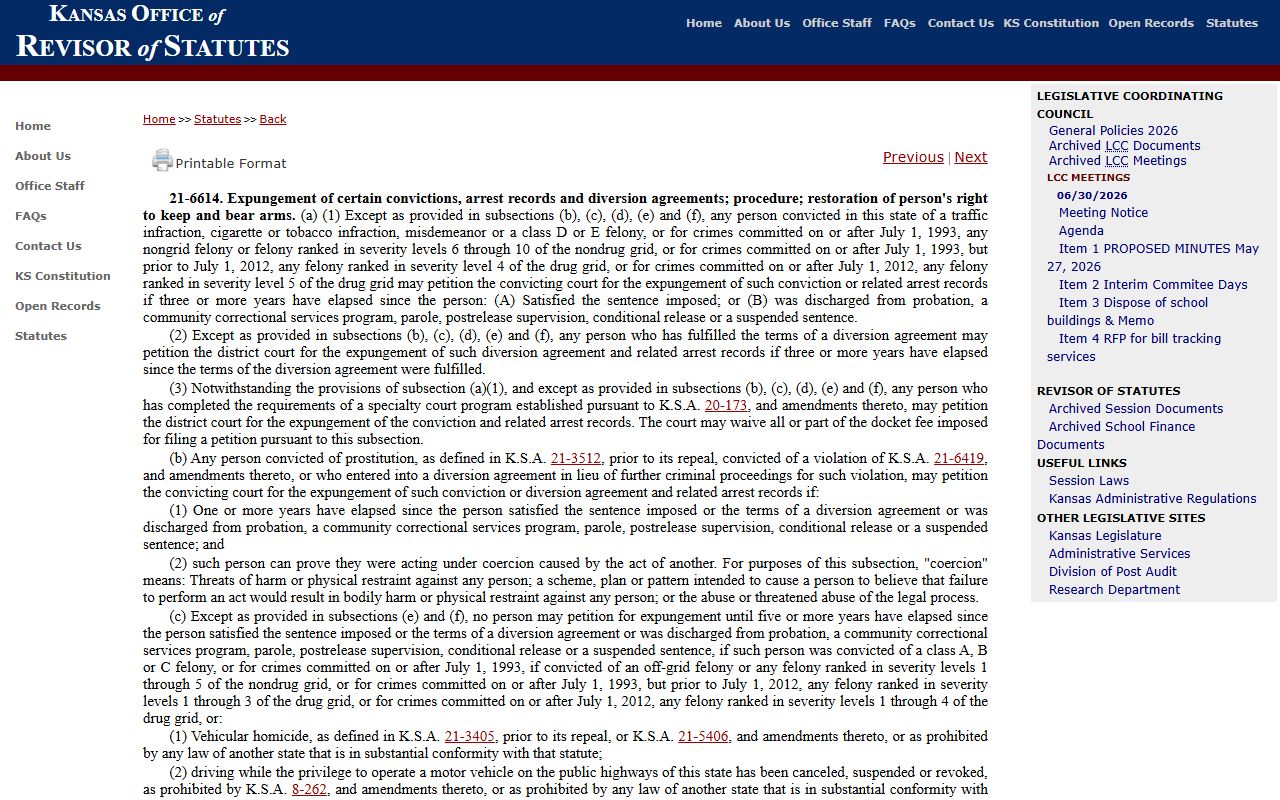
The statute matters because an expunged Rice County criminal record may not appear in the same way as an ordinary public criminal case.
Public Access to Rice County Criminal Records
Adult criminal court records are generally public unless a law, court rule, or order restricts access. Kansas Supreme Court Rule 22 governs public electronic access to district and appellate case records. K.S.A. 45-215 anchors the Kansas Open Records Act for public agency records, and K.S.A. 45-221 within the public records chapter lists categories that public agencies are not required to disclose.
Key Statutes:
K.S.A. 20-301 establishes district courts in Kansas counties with general original jurisdiction.
K.S.A. 21-6614 allows petitions to expunge eligible convictions, arrests, and diversions under stated conditions.
Victims and Offender Records
The Rice County Attorney Victim/Witness page says victims are notified when charges are filed in misdemeanor and felony cases in adult and juvenile courts, and about arraignment, preliminary hearings, trials, and sentencing hearings. Those notices help victims follow the criminal court record as key docket events occur. Juvenile and victim-sensitive details may still be restricted from public display.
The Rice County Victim/Witness page explains local notification when criminal charges are filed and as hearings are set.

Victim notification is tied to case progress, but the public docket may still redact or withhold protected victim or juvenile information.
The KBI Registered Offender Website is a separate statewide public registry source under Kansas offender registration law.
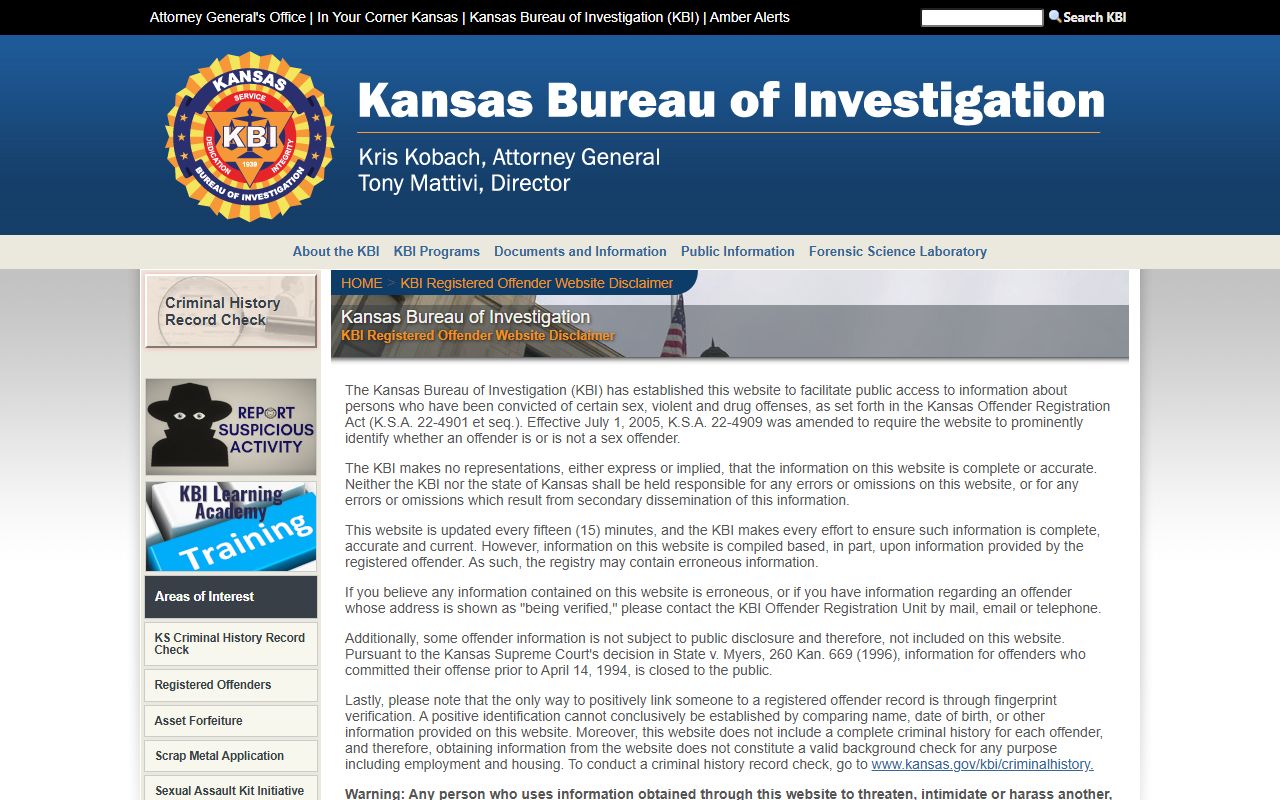
The KBI registry can relate to some convictions, but it does not replace the Rice County court docket, disposition, or sentencing entry.
Restricted Rice County Criminal Records
Juvenile offender, child in need of care, sealed, expunged, mental health, care and treatment, and protected personal identifier material is not open like an ordinary adult criminal case. Public records may redact Social Security numbers, driver license numbers, financial account numbers, minor names, protected addresses, medical information, and other sensitive data. Search results can be limited or absent when the law blocks public access.
For appointed counsel questions, the research file found no standalone official Rice County public defender office page. A defendant seeking appointed counsel procedures should ask Rice County District Court. For active warrants, custody, and jail status, separate sheriff and detention channels apply. The court case file remains the best source for filed charges, pleas, dispositions, and sentencing after the case is opened.
Important: Criminal court records may be incomplete online, so verify liberty, employment, licensing, or court appearance issues with the originating court.